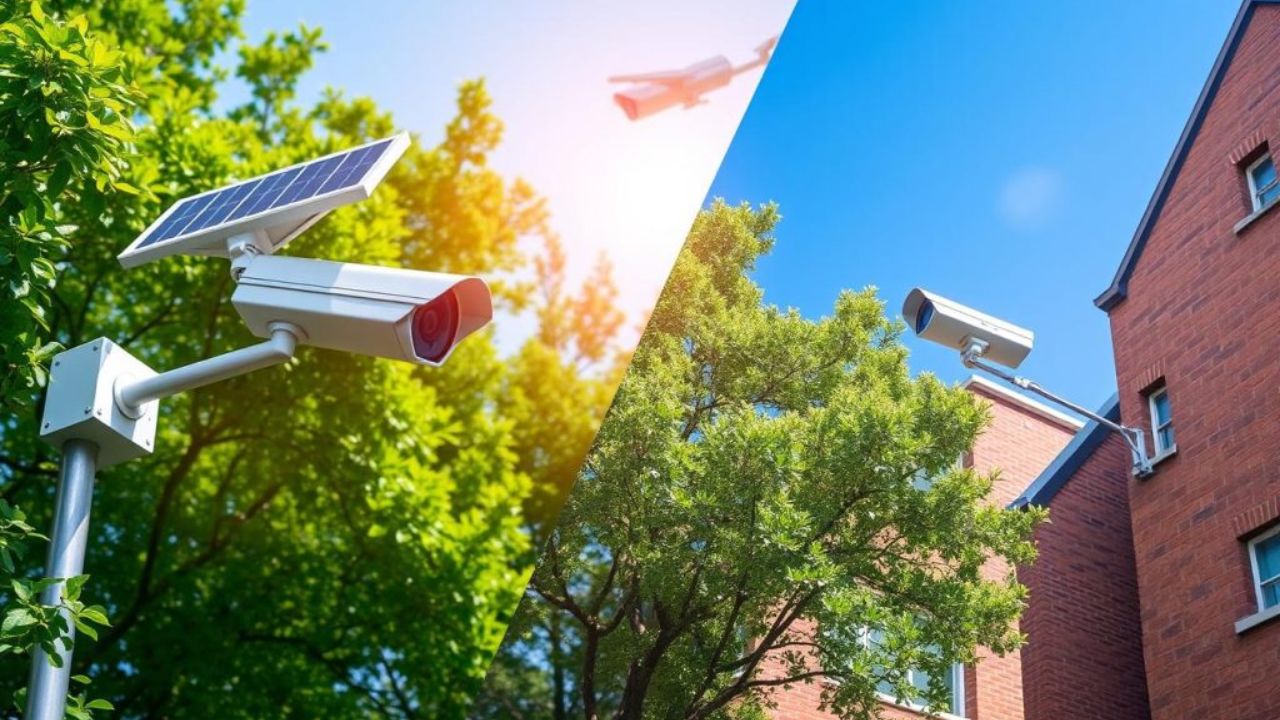
When making a purchase of a modern surveillance solution, a solar cctv camera is usually compared by buyers with traditional security cameras. Both systems play the same fundamental role: safety and property monitoring. However, these two systems differ in power source, installation, cost in the long run, and performance in diverse environments. The knowledge of these differences will assist the homeowners and businesses in deciding which option is ultimately more valuable.
Energy Efficiency and Power Source
Among the most evident differences that the two systems have is their power. Old security cameras are based on electrical wiring or a power outlet, which is constantly active; thus, they are dependable in places with a stable power supply. Nevertheless, they tend to have restricted locations of their installation due to their need to be constantly powered. When the area is not wired or far away from a power source, then the installation turns more complicated and more costly.
The solar security cameras run on renewable energy with inbuilt or mounted solar panels. They have built-in batteries that power them all day long and even at night or during periods of low light. This is energy-independent, which provides them with a significant advantage in remote or off-grid locations. They will ensure 24/7 monitoring as long as there is enough sunlight and it does not depend on electrical lines.
Installation Adaptability and Costs
Old systems are usually professionally installed, particularly when drilling cables along walls or ceilings or underground conduits. This not only adds to labor expenses but also increases the setup time. These installations may be even more challenging when it comes to properties in construction or facilities that are large.
Solar security surveillance cameras are far more flexible. They do not need to be wired, and thus can be hung on poles, on the walls, sheds, and other outdoor buildings, without changing the property. It is easy to install and it normally only requires a few minutes. Moreover, they are cost-effective because they can be installed even where there is no electrical work, and this is particularly effective in large buildings, farms, car parks, or building sites where it may be either impractical or prohibitively expensive to install the wiring.
The Performance and Reliability
Traditional security cameras have long been a stable performance-wise because they have had a constant power supply. They are not very sensitive to weather conditions and can work twenty-four hours as long as the grid is stable. Nevertheless, failure of power or a broken wire can render the whole system useless.
The solar-powered cameras have been getting better in recent years. The battery technology development, high-efficiency solar panels, and smart features that save power enable them to operate dependably even on rainy days. A large number of models are supplied with dual power systems to make sure that they do not stop working even in times of poor weather. Moreover, the 4G LTE or dual-band Wi-Fi cameras make use of the sun as a power source and remain connected even in case the local network fails.
Cost Over Time
The start-up expenses of the two are dissimilar. The conventional cameras may seem cheaper initially, but the extra costs will soon arise in the form of installation fees, wires, and the cost of electricity consumption. With time, such recurring costs increase their maintenance costs.
Solar security cameras might be a little more costly to install, but they do not require electricity bills. Their extended power supply batteries and self-sufficient solar panels significantly lower the maintenance costs, resulting in significant savings in the long run. Solar systems are often more cost-effective for homeowners and businesses with long-term needs.
Environmental Impact and Sustainability
Sustainability is now a significant parameter for most users. Conventional cameras are dependent on power produced with the help of traditional sources of power, which also leads to environmental effects in the long term. On the contrary, the solar security cameras run on renewable energy that is clean. Their green construction minimizes the carbon footprint and promotes power-saving, long-term monitoring.
Conclusion
The best type of camera is the one that allows users to obtain improved value, which ultimately depends on the user’s needs. The conventional cameras are still applicable in the regions where the wiring and power supply are already available. They are reliable and effective when confined in a controlled setting.
Nevertheless, Solar security cameras offer unmatched flexibility, energy, and energy independence. They are also very efficient in remote sites, outdoors, and any other place where users desire fast installation without incurring the cost of maintenance. In the majority of cases of contemporary usage, solar-powered security cameras are the best value offer because they are more sustainable, require less lifetime costs, and have 24/7 functionality.